Pink Diamonds: A Guide to Australian Pink Diamonds
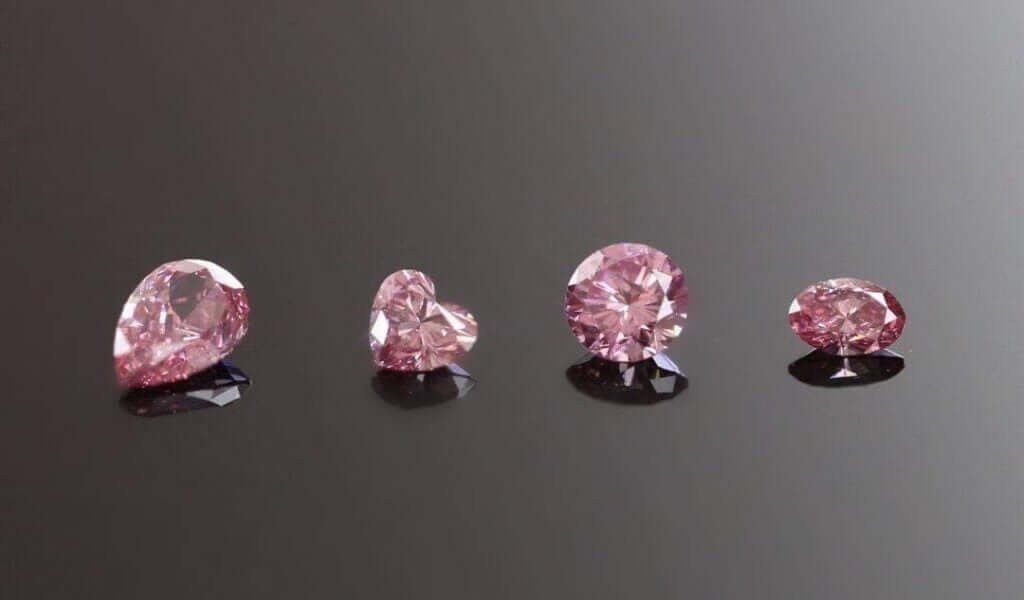
Pink gemstones capture the attention of the masses like no other. Whether that be a soft blush tone, or a vidid, bold and rich hue, these incredible diamonds are regrded highly for their rarity, colour and individuality.
Australia holding a very important part in their history.
For decades, the Argyle diamond mine in Western Australia was one of the world’s largest sources of natural pink diamonds. Since it closed in the year of 2020, any diamonds originating from this mine have become an increasingly rare and coveted worldwide.
At MDT DESIGN, our Melbourne jewellers work with natural pink diamonds, helping clients understand their unique characteristics and creating individually handmade jewellery that celebrates their beauty.
What Makes a Pink Diamond Pink?
The pink colour in most of the natural pink diamonds isn’t caused by chemical impurities, unlike other gemstones.
Instead, it is a result of changes within the diamond’s crystal structure, caused by intense geological forces. These forces affect how the diamond itself absorbs light, resulting in a distinctive pink appearance.
Research from the Gemological Institute of America (GIA), suggests that the structural characteristics responsible for pink colour are a very important factor of what makes these diamonds so unique.
Australian Pink Diamonds and The History of the Argyle Mine
The Argyle mine is located in Western Australia in the East Kimberley region. When open the Argyle diamond mine was responsible for an excess of 90% of the entire world’s pink diamond supply.
Despite the mine’s enormous diamond production, pink diamonds represented only a tiny fraction of the diamonds recovered.
After 37 years of operation, mining officially ended in November 2020.
The closure marked the end of one of the world’s most significant sources of natural pink diamonds. Today, diamonds recovered from the former mine are especially desirable for their rarity, Australian heritage and documented provenance.
To learn more about the Argyle mine, visit Rio Tinto’s official Argyle mine information page.

Can You Still Buy Australian Pink Diamonds?
Yes, you can. Even though the Argyle mine is no longer currently operating, diamonds that are previously recovered are available through existing inventories.
It is important to note that not all natural pink diamonds originate from Australia, and not all Australian pink diamonds come from the argyle mine.
When purchasing a diamond, it is important to ask for appropriate documentation, to know its true origin.
How Are Pink Diamonds Graded?
Similar to white diamonds, pink diamonds are assessed by characteristics; cut, clarity and carat weight.
However when grading a pink diamond, the colour is usually the most influential factor in determining their true value.
The GIA uses colour grades such as Faint, Very Light, Fancy Light, Fancy Intense, Fancy Deep and Fancy Vivid to describe different appearances of coloured diamonds.
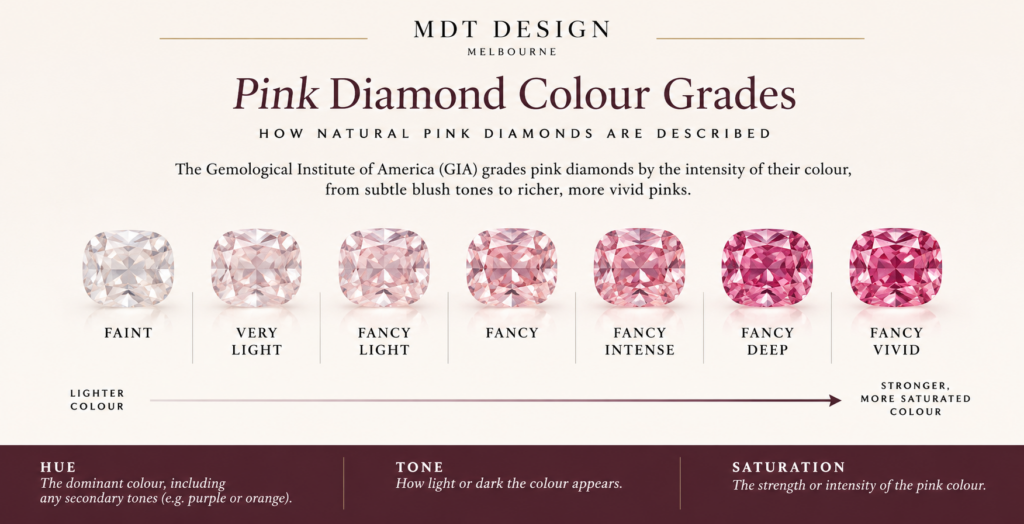
For those in the market, this will mean a smaller diamond with an exceptional natural colour could be considerably more valuable than a larger diamond with a lesser pink appearance.
To learn more about colour and other considerations, explore the GIA’s guide to pink diamond engagement rings.
Are All Pink Diamonds the Same Shade?
Not at all.
Some natural pink diamonds display delicate pastel colouring, while others exhibit stronger pink, purplish-pink or orangy-pink tones.
Even diamonds of similar size can look noticeably different when a undergoing a side by side comparison.
The individuality of each pink diamond is a big factor in their mass appeal, especially when selecting a gemstone for a custom piece of jewellery.
Why Are Natural Pink Diamonds So Valuable?
Natural pink diamonds are among the rarest coloured diamonds, particularly in larger sizes with strong, attractive colour.
Their value is influenced by several factors:
| Factor | How It Influences Value |
|---|---|
| Colour Intensity | Stronger, desirable natural pink colour can command significant premiums. |
| Carat Weight | Larger natural pink diamonds are exceptionally difficult to source. |
| Cut | Proportions and cutting quality influence appearance, brilliance and colour presentation. |
| Clarity | The type and visibility of inclusions can affect value. |
| Provenance | Documented origin from Australia’s former Argyle mine can add significance for collectors. |
Although rare pink diamonds are highly desirable, future resale values are not guaranteed.
Natural vs Lab-Grown Pink Diamonds: What’s the Difference?
Natural and lab-grown pink diamonds are both diamonds, but their origin, rarity, value and characteristics can vary.
Natural pink diamonds form deep within the Earth over geological timescales. Their pink colour may result from structural changes caused by natural geological processes.
Lab-grown pink diamonds are created in controlled environments. Their colour can be produced or modified through specialised manufacturing and treatment processes.
| Natural Pink Diamonds | Lab-Grown Pink Diamonds |
|---|---|
| Formed naturally within the Earth over geological timescales. | Manufactured in controlled laboratory environments. |
| Exceptionally rare in desirable pink colours. | Can be produced with pink colouring. |
| May have documented Australian mine provenance. | Do not have natural geological mine provenance. |
| Typically command substantially higher prices. | Generally more accessible in price. |
A lab-grown pink diamond can be visually beautiful, but it does not possess the same natural rarity or geological history.
When considering either, an independent gemological report assist you in establishing the diamond’s origin and whether its colour is natural or treated.
Choosing a Pink Diamond for an Engagement Ring
Pink diamonds can make for an incredible engagement ring centre stone, but they can also be used fabulously as accent diamonds alongside white diamonds or other gemstones.
The colour of your pink diamond can be complemented or contrasted through the intentional selection of precious metal.
At MDT DESIGN we generally recommend setting your pink diamond in Rose Gold.
Rose gold can enhance the depth of softer pink tones, while white gold or platinum may provide a contrasting appearance that draws attention to the diamond’s natural colour.
The use of contrasting yellow gold can offer another unique option of contrast, especially for designs that may feature many different diamond colours.
The setting itself also matters. The proportions, surrounding gemstones and amount of visible metal can all influence how a pink diamond appears in the finished ring.
At MDT DESIGN, every ring is individually handmade in our Melbourne workshop, allowing the design to be tailored to the selected gemstone rather than relying on a standard mass-produced setting.
Explore our Pink Diamond Engagement Rings or discover the possibilities of custom-designed jewellery.
Frequently Asked Questions About Pink Diamonds
Are pink diamonds rarer than white diamonds?
Yes they are. A Natural pink diamond is much rarer than colourless diamonds, even more so when they display strong, vivid pink colouring.
Are all Australian pink diamonds from the Argyle mine?
No. Although the Argyle mine was Australia’s most famous source of pink diamonds. The term Australian pink diamond can refer to a more broad region.
If there are claims that a diamond is specifically from the Argyle mine, we suggest you request doccuments to support that.
Are pink diamonds a good investment?
Natural pink diamonds can be desirable collector gemstones, especially when they have exceptional colour and documented provenance. The argyle mines closure in 2020 suggests that they are increasingly rare, however, their future value depends on market demand and each diamonds individual characteristics, and it is important to understand that appreciation is never guaranteed.
Can pink diamonds be worn every day?
Yes. Like other diamonds, pink diamonds rank 10 on the Mohs scale of mineral hardness, making them highly resistant to scratching.
However, diamonds can still chip or fracture if struck, so a carefully constructed setting and intentional design is essential for jewellery intended for everyday wear.
How can I tell if a pink diamond is natural?
Appearance alone isn’t sufficient to determine whether a pink diamond is natural or laboratory-grown.
An independent gemological report can help establish its origin and whether the colour is natural or treated. Documentation of a particular mine’s provenance is a separate consideration.
Discover Pink Diamonds at MDT DESIGN Melbourne
If you are exploring the possibilities of a custom engagement ring featuring a Pink Diamond it is very important to start with the right gemstone and understanding its individual qualities.
MDT DESIGN, established in 1981, is a family-owned Melbourne jeweller specialising in individually handmade fine jewellery.
Our knowledgable designers and jewellers can guide you through gemstone education, selection, talke about the precious metals and assist you with custom design, creating jewellery that celebrates the individual character of your chosen diamond.
Visit our Collins Street boutique to discuss your ideas.