How Much Electricity Does It Take to Grow a Lab-Grown Diamond?
Comparing 1, 1.5, 2, 3 and 4-carat lab-grown diamonds with Australian household electricity consumption.
Lab-grown diamonds have become increasingly popular for engagement rings, offering the same chemical composition, crystal structure and physical properties as natural diamonds, generally at a lower purchase price.
But how much electricity does it actually take to produce one?
The answer is a lot more complicated than just measuring the electricity required to grow a diamond. We also have to consider that if a finished polished diamond begins as grown rough diamond, it must then be cut and polished, often losing a significant proportion of its original weight.
At MDT DESIGN, we work with both natural and lab-grown diamonds. Using the published research available, we have examined how production technology and cutting yield can affect the electricity consumption and energy used, then we have compared the findings with Victorian household electricity usage to give us a better idea of the energy really used.
Key Findings: Lab-Grown Diamond Electricity Consumption
• 591 kWh per polished carat: An adjusted historical estimate reported in a 2019 Trucost assessment of published production data.
• 92 days of total household electricity: Under this estimate, producing a finished 2-carat lab-grown diamond requires electricity equivalent to approximately 92 days of consumption for our example Victorian household.
• Rough versus finished diamond weight matters: Producing a finished 1-carat diamond will require more than 1-carat of rough diamond, depending on cutting yield.
These are illustrative comparisons, not universal industry averages. Actual electricity requirements do vary with how the stones are grown, equipment efficiency, crystal size and the manufacturing conditions.
There are two prime ways lab grown diamonds can be made:
High Pressure High Temperature (HPHT) uses specialised presses to expose carbon to extremely high pressures and temperatures, allowing diamond crystals to develop around a diamond seed.
Chemical Vapour Deposition (CVD) uses a controlled chamber containing gases of typically hydrogen and methane. The energy creates a plasma that then allows carbon atoms to accumulate on a diamond seed.
Both of these processes require a substantial amount of electricity, although the energy consumption can differ between the two.
A 2021 peer-reviewed study published in Energies examined that electricity requirements for selected diamond-growing types.
Production configuration Electricity per rough diamond carat
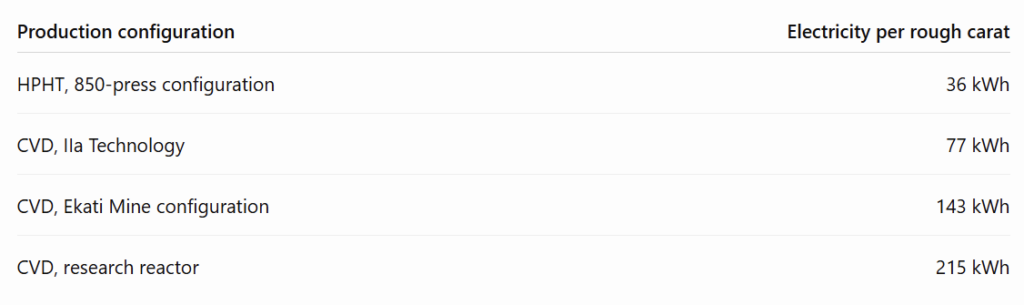
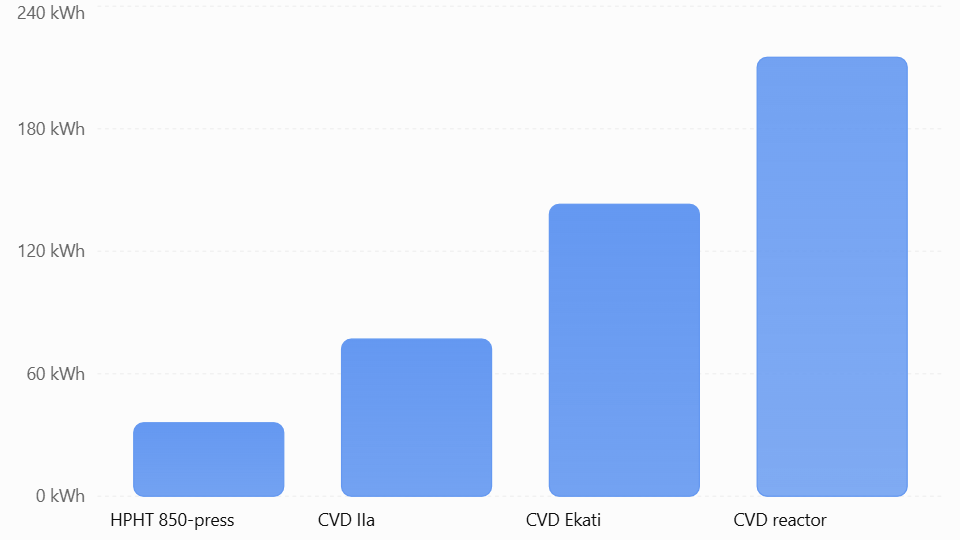
Source: Zhdanov et al., Energies (2021). Selected production configurations, measured in kWh per rough carat.
The researcher’s CVD reactor figure was approximately 214.72 kWh per rough 1-carat diamond, here we will simply round to 215 kWh.
These results demonstrate the large differences between each of the processes. They should not be interpreted as exact averages for every single HPHT or CVD facility producing lab grown diamonds.
Importantly, these figures refer to electricity consumed during rough diamond production, before cutting and polishing. They do not represent the total electricity required to produce a finished polished lab-grown diamond.
How Much Rough Diamond Is Needed to Produce a Finished Diamond?
It’s important to take into account that a cut and polished 1-carat diamond does not begin as a 1-carat rough diamond crystal.
While the diamond is being cut and polished, raw diamond material is removed to achieve the shape, proportions and symmetry of the finished stone.
For example, creating a finished 1-carat diamond from a 1.5-carat rough crystal represents a cutting yield of approximately 67% and a loss of 33%.
However, actual cutting yields can vary considerably based on the rough diamond crystal’s shape, inclusions in the stone and the desired finished result.
To demonstrate the difference, MDT DESIGN has calculated three illustrative scenarios: approximately 67%, 40% and 25% yield.
Rough Diamond Required at Different Cutting Yields
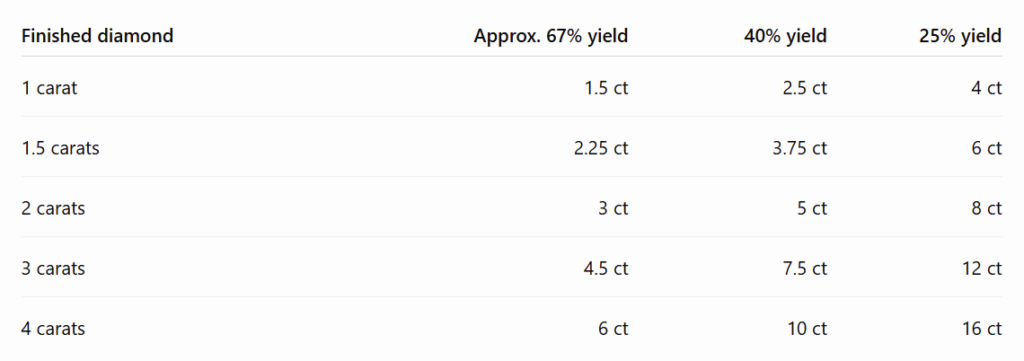
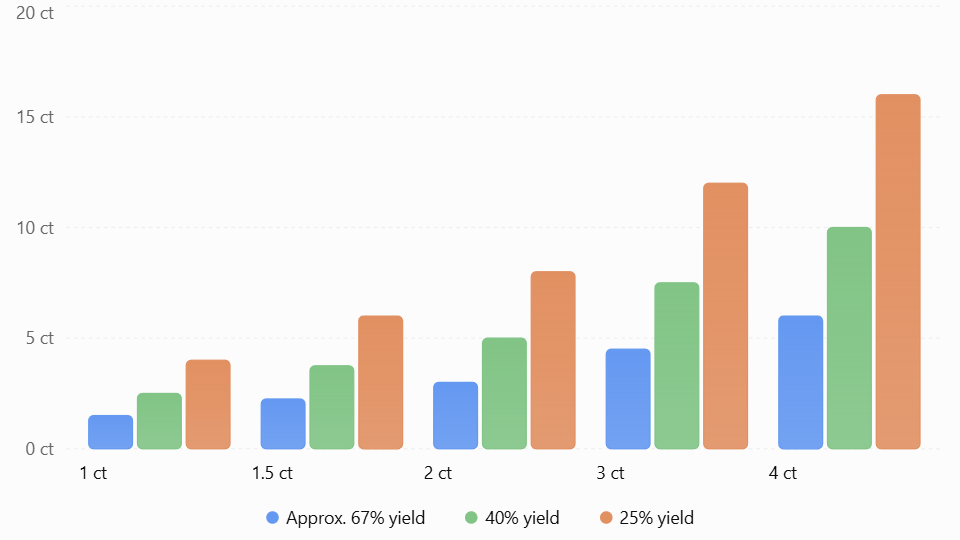
Illustrative calculations by MDT DESIGN showing the rough diamond weight required at different cutting yields.
These are mathematical examples, not measured industry averages for diamonds of these sizes.
Why Does Cutting Yield Matter for Electricity Consumption?
Consider the CVD research reactor, which requires approximately 215 kWh per rough 1- carat.
Depending on the amount of rough diamond required to produce a finished 1-carat gemstone, the electricity needed for crystal growth can vary substantially. A larger rough crystal may be necessary to achieve the desired shape, proportions and overall appearance of the finished diamond.
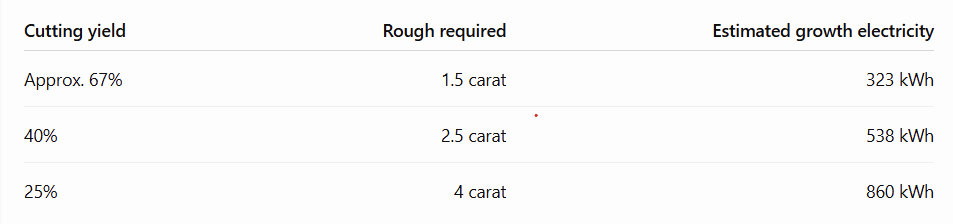
These calculations assume constant electricity consumption per rough 1-carat of diamond and excludes separate cutting, polishing and transport requirements that may be needed to end up with the finished stone.
The important distinction to note here is that the electricity consumption per rough 1-carat of diamond and the electricity consumption per finished polished 1-carat are not interchangeable measurements.
How Much Electricity Does a Finished 1, 1.5, 2, 3 or 4-Carat Lab-Grown Diamond Require?
A 2019 assessment by Trucost, part of S&P Global, published estimates of lab-grown diamond production electricity consumption.
The report, The Socioeconomic and Environmental Impact of Large-Scale Diamond Mining, reported an adjusted historical average of 591 kWh per finished polished carat, with an adjusted range of 332–850 kWh
These figures were calculated from available historical estimates after excluding some selected extreme values. The research was commissioned by the Diamond Producers Association, representing natural diamond producers.
As a result of this, it should be understood as a historical research benchmark, not a definitive measurement of the current global lab-grown diamond production.
Using 591 kWh per polished 1-carat, MDT DESIGN calculated the following examples:
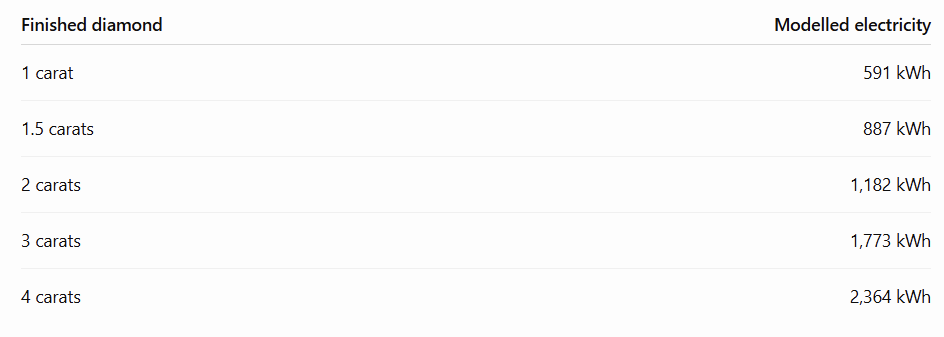
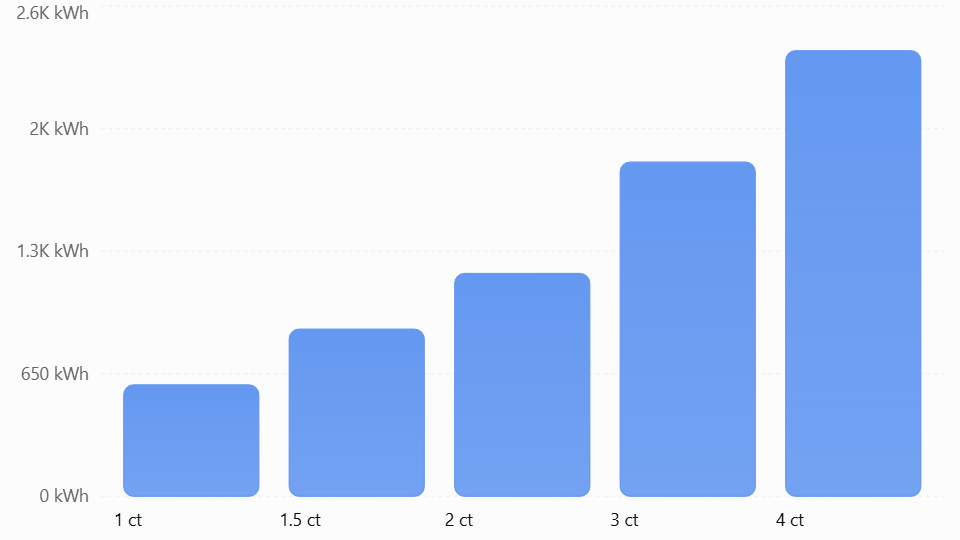
MDT DESIGN calculations based on Trucost/S&P Global’s 2019 historical estimate of 591 kWh per polished carat.
These calculations assume that the electricity consumption increases proportionally with the finished carat weight.
In practice, much larger diamonds can require different growth conditions, production times and cutting and polishing strategies. The actual electricity consumption used does not necessarily increase at a constant rate.
The Trucost estimate shows only diamond-production electricity rather than a complete life-cycle energy footprint of the diamond.
How Does This Compare with Australian Household Electricity Consumption?
Electricity consumption is measured in kilowatt-hours (kWh). One kWh represents the electricity consumed by a 1,000-watt appliance running for one hour.
The Australian Energy Regulator’s Annual Retail Markets Report from 2024–25, reports average annual residential electricity consumption ranging anywhere from around 4,434 to 4,964 kWh across Victoria’s five electricity distribution areas.
For our comparison here, we have based the findings of an average rounded benchmark of 4,700 kWh annually, equivalent to approximately 12.9 kWh per day per household.
This is an illustrative Victorian household figure, not an official statewide average.
Lab-Grown Diamond Electricity Compared With Household Usage
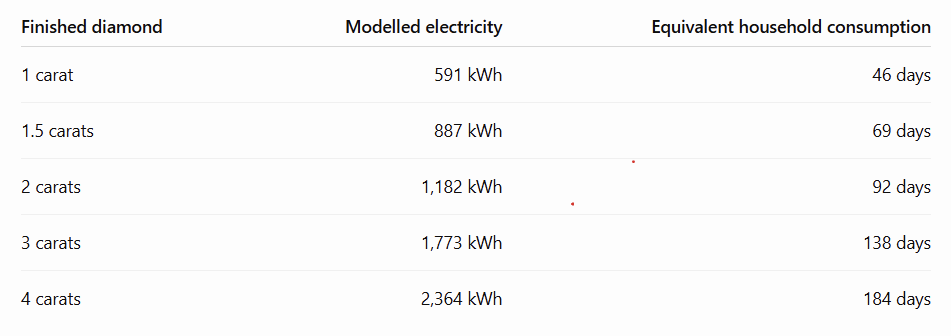
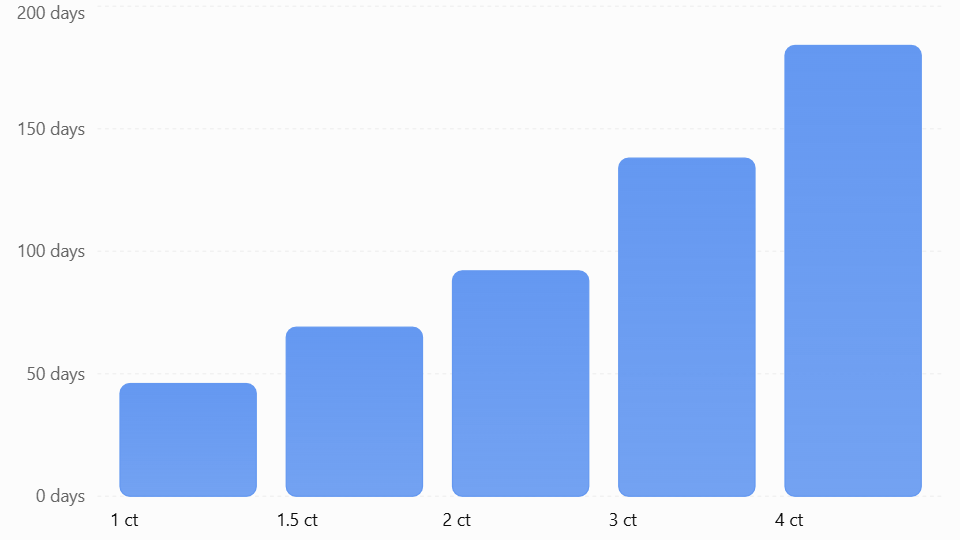
MDT DESIGN calculations using Trucost/S&P Global’s historical electricity estimate and an illustrative Victorian household consumption benchmark of 4,700 kWh annually, informed by Australian Energy Regulator data.
Under this illustrative scenario, a finished 2-carat lab-grown diamond needs electricity equivalent to approximately three months consumption for our example of a Victorian household.
If we look at a 4-carat diamond, the equivalent increases to approximately six months.
These comparisons only describe the equivalent quantities of electricity, not actually how long a diamond takes to grow.
What About Australian Rooftop Solar?
Solar energy provides another useful perspective of how much energy these lab grown diamonds will take to grow.
According to the Australian Government solar guidance, Melbourne rooftop solar panels can generate around 3.6 kWh per installed kilowatt per day, this is averaged out across the year.
A 6.6 kW household solar system would therefore generate around 23.8 kWh per day.
Based on this average output, a 6.6 kW Melbourne rooftop solar system would take approximately 50 days to generate electricity equivalent to the modelled production requirement of a finished 2-carat lab-grown diamond.
With actual solar generation varying with the seasons, weather, system orientation and other conditions that come into play.
This is an electricity-equivalence comparison only and not a suggestion that a residential solar system could actually directly operate any commercial diamond-growing machine.
Are Lab-Grown Diamonds More Environmentally Friendly Than Natural Diamonds?
Electricity consumption is only one aspect of a diamond’s environmental impact.
An Earth made natural diamond first involves mining the stone and processing it, while with a lab-grown diamond, it requires specialised industrial equipment and machinery in a controlled growth environment.
The source of the electricity used will also matter. Factories powered by renewable electricity can have a much lower electricity-related greenhouse gas emissions than a factory that only relies on fossil fuels.
A comprehensive environmental assessment must also take into consideration the machinery, materials, water consumption, land disturbance, cutting, polishing and transport of the finished stone.
Most importantly, both production methods must be assessed using equivalent boundaries.
Comparing rough natural diamonds with a finished polished lab-grown diamond, or vice versa, can lead to misleading conclusions.
The true environmental impact of any diamond also depends on how and where it was produced, not simply just whether it was a mined natural diamond or grown in a laboratory.

Choosing a Diamond With a Better Understanding of Its Production
At MDT DESIGN, we believe consumers should have access to balanced, reliable and unbiased information when choosing between natural and lab-grown diamonds.
Every piece of MDT DESIGN jewellery is individually handmade in our on-site Melbourne workshop, with particular attention to strength, durability and long-term wearability.
Both natural and lab-grown diamonds can be used to create beautiful, enduring jewellery. Understanding how diamonds are produced provides valuable context, but our expertise remains focused on the quality, construction and longevity of the finished piece.

Kosta’s Expert Jeweller Tip
When comparing electricity consumption figures for lab-grown diamonds, always check whether the measurement refers to rough or finished polished diamond weight.
The amount of rough material required, the cutting yield and machinery and equipment used can change the calculation substantially.
Without the exact details, comparisons between different manufacturers can be misleading.
Frequently Asked Questions
How much electricity does a 1-carat lab-grown diamond require?
The 2019 Trucost assessment reported an adjusted historical estimate of approximately 591 kWh per finished polished 1-carat. the actual requirements can vary between manufacturers and the exact production method.
How much rough diamond is required for a finished 1-carat diamond?
There is no fixed amount. At approximately 67% cutting yield, a 1.5-carat rough diamond could produce a finished 1-carat diamond. Lower yields require more rough material to begin with.
Does a 4-carat lab-grown diamond require four times as much electricity as a 1-carat diamond?
Not necessarily. Although our illustrative model scales electricity consumption by carat weight, the actual requirements will depend on the growth conditions, crystal size, machinery efficiency and cutting yield.
Can lab-grown diamonds be produced using renewable electricity?
Yes. Diamond-growing factories can use renewable electricity like solar and wind power. The environmental benefit will depend on the facility’s actual electricity supply.
________________________________________
Research Sources and Methodology
Research comparison and calculations: MDT DESIGN, Melbourne, Australia.
This article combines published research with illustrative calculations prepared by MDT DESIGN. It does not present new measurements from diamond-growing facilities.
Primary sources:
- Zhdanov et al. (2021), A Comparative Analysis of Energy and Water Consumption of Mined versus Synthetic Diamonds, Energies.
- Trucost / S&P Global (2019), The Socioeconomic and Environmental Impact of Large-Scale Diamond Mining, Appendix 1, Table 5.
- Australian Energy Regulator, Annual Retail Markets Report 2024–25.
- Australian Government, Solar Panels.
Calculation assumptions: 591 kWh per finished polished carat; 215 kWh per rough carat for the cutting-yield example; illustrative cutting yields of approximately 67%, 40% and 25%; Victorian household electricity consumption of 4,700 kWh annually; and average Melbourne solar generation of 3.6 kWh per installed kW daily.
The Trucost figure is a historical adjusted average from published estimates, not a current industry-wide exact measurement. Its scope does not represent a complete life-cycle energy assessment of a lab grown diamond. Figures for different finished diamond sizes are mathematical extrapolations rather than independently measured results.
All calculations are rounded and estimates from different studies should not be treated as directly interchangeable without considering their methodologies.